09 Jun

Counterfeit goods have evolved into one of the most serious challenges facing global commerce. From luxury handbags and designer watches to life-saving medications and medical devices, counterfeit products cost businesses hundreds of billions of dollars annually while posing significant risks to consumers worldwide.
For luxury brands, counterfeiting damages reputation, undermines exclusivity, and erodes consumer trust. In the pharmaceutical industry, however, the consequences are even more severe. Counterfeit medicines can lead to treatment failures, serious health complications, and, in some cases, loss of life.
Traditional anti-counterfeiting technologies—including holograms, serial numbers, and paper certificates—have become increasingly vulnerable to sophisticated forgery techniques. As counterfeiters adopt advanced manufacturing capabilities, businesses must seek stronger, more intelligent methods of product authentication.
Web3 technologies and blockchain-based digital product passports are rapidly emerging as game-changing solutions. By assigning every product a unique and cryptographically secured digital identity, manufacturers can create an immutable record that proves authenticity at every stage of the supply chain.
The fight against counterfeiting is entering a new era—one where consumers can verify authenticity instantly and counterfeit products become significantly harder to introduce into global markets.
The Global Counterfeit Problem
Counterfeit products affect virtually every major industry, including:
- Luxury fashion
- Pharmaceuticals
- Electronics
- Cosmetics
- Automotive parts
- Consumer goods
- Food and beverages
The economic consequences include:
- Lost revenue for legitimate businesses
- Increased operational costs
- Damaged brand reputation
- Regulatory challenges
- Consumer distrust
In addition to financial losses, counterfeit pharmaceuticals pose significant public health risks. Fake medicines may contain:
- Incorrect ingredients
- Improper dosages
- Harmful substances
- No active ingredients at all
Ensuring product authenticity is no longer simply a business concern—it has become a matter of consumer safety.

Why Traditional Authentication Methods Fall Short
Conventional anti-counterfeit measures typically rely on:
- Printed certificates
- Barcodes
- Packaging labels
- Serial numbers
- Security holograms
While useful, these solutions have several limitations:
- They can be copied.
- They are often difficult to verify independently.
- They may require centralized databases.
- Consumers rarely have access to reliable verification tools.
Sophisticated counterfeit operations can replicate many physical security features with alarming accuracy.
As global supply chains become increasingly complex, businesses require authentication systems that are both secure and easily accessible.
This is where Web3 technologies provide a significant advantage.
What Is a Digital Product Passport?
A digital product passport is a blockchain-based identity assigned to an individual product.
It contains verified information such as:
- Manufacturing details
- Production dates
- Product specifications
- Ownership history
- Supply chain records
- Authenticity credentials
Unlike traditional databases, blockchain ensures that this information cannot be altered retroactively.
Each product effectively receives its own cryptographic fingerprint that remains permanently linked to its digital identity.
Consumers, retailers, and authorized supply chain participants can verify product authenticity with confidence.
How Blockchain Secures Product Authenticity
Blockchain technology offers several important characteristics that make it highly effective for anti-counterfeiting purposes:
Immutability
Once information is recorded, it cannot be modified without authorization and consensus.
Transparency
Supply chain events can be securely tracked and verified throughout the product lifecycle.
Decentralization
Authentication records are not dependent on a single centralized authority.
Cryptographic Security
Digital identities are protected using advanced cryptographic techniques that are exceptionally difficult to forge.
Together, these capabilities create a highly secure framework for product authentication.
Luxury Brands Enter the Web3 Era
Luxury products derive much of their value from exclusivity and authenticity.
Consumers purchasing premium products increasingly expect:
- Proof of authenticity
- Ownership verification
- Transparency regarding origin
- Secure resale capabilities
Blockchain-powered digital passports provide luxury brands with several strategic advantages.
Every item can be associated with:
- A unique digital certificate
- Manufacturing records
- Ownership transfers
- Maintenance history
- Authenticity verification tools
This approach benefits both primary and secondary markets.
Transforming the Luxury Resale Market
The global luxury resale market continues to grow rapidly, but concerns regarding counterfeit products remain significant.
Many consumers hesitate to purchase pre-owned luxury items because they cannot confidently verify authenticity.
Blockchain-based product passports enable:
- Secure ownership transfers
- Permanent authenticity records
- Transparent resale histories
- Increased buyer confidence
Consumers can instantly determine whether an item is genuine and trace its legitimate ownership history.
This has the potential to significantly increase trust in luxury resale ecosystems.
Protecting Pharmaceutical Supply Chains
The pharmaceutical industry faces unique challenges that make blockchain particularly valuable.
Medications frequently travel through multiple supply chain participants, including:
- Manufacturers
- Packaging facilities
- Distributors
- Logistics providers
- Pharmacies
- Healthcare institutions
Each handoff presents potential vulnerabilities that counterfeiters may exploit.
Blockchain-powered product authentication allows pharmaceutical companies to track:
- Manufacturing batches
- Shipment records
- Storage conditions
- Distribution timelines
- Product recalls
- Pharmacy deliveries
Every legitimate medication package can be uniquely identified and verified.
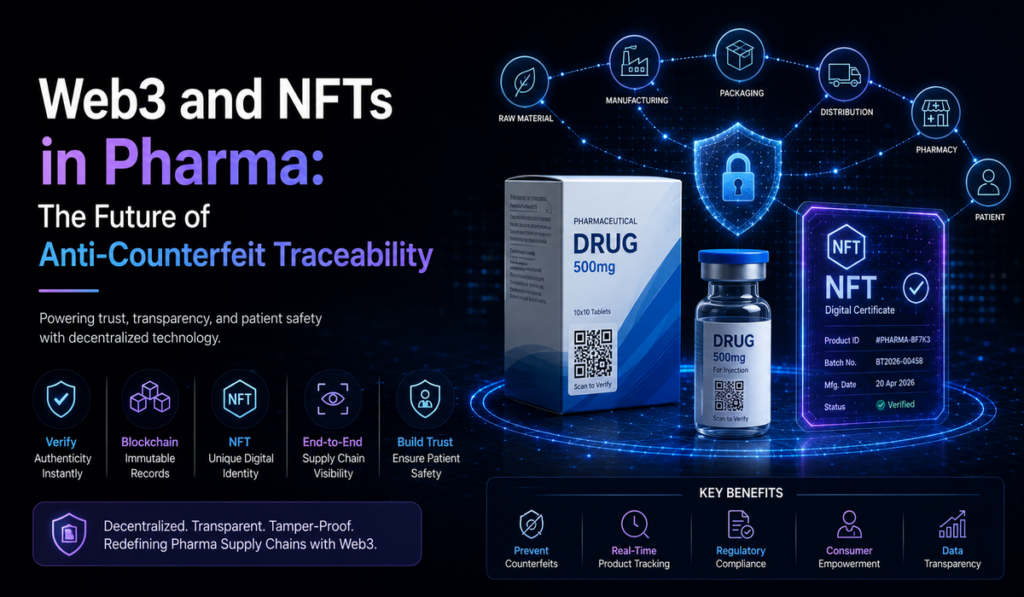
Consumer Verification in Seconds
Perhaps one of the most important advantages of digital product passports is their simplicity.
Consumers can verify product authenticity using:
- A smartphone.
- A QR code or secure NFC tag.
- Blockchain verification tools.
Within seconds, users can access:
- Product origin
- Manufacturing details
- Supply chain records
- Authenticity confirmation
- Ownership information when applicable
Authentication becomes accessible to everyone rather than being limited to industry experts.
Counterfeit Products Become Easier to Detect
Counterfeit goods often rely on information asymmetry.
Consumers typically cannot determine whether:
- Packaging is authentic.
- Documentation is legitimate.
- Supply chain records are accurate.
Blockchain significantly reduces these information gaps.
If a product’s digital passport cannot be verified, consumers immediately know that further investigation is warranted.
The absence of an authentic blockchain record becomes a powerful indicator that something may be wrong.
Beyond Authentication: Smart Product Ownership
Web3 technologies also introduce new possibilities for digital ownership management.
Digital product passports may eventually support:
- Warranty management
- Maintenance records
- Insurance services
- Product registration
- Secondary market transactions
- Customer loyalty programs
Ownership itself becomes programmable and transferable through secure digital infrastructure.
This creates entirely new opportunities for businesses to engage with consumers throughout a product’s lifecycle.
Benefits for Businesses
Blockchain-based authentication solutions offer significant advantages for manufacturers and retailers.
Reduced Counterfeit Losses
Businesses can better protect:
- Revenue
- Intellectual property
- Brand reputation
Improved Consumer Trust
Transparent authentication systems strengthen relationships between brands and customers.
Enhanced Supply Chain Visibility
Manufacturers gain better oversight of product movement across global markets.
Greater Regulatory Compliance
Industries facing strict compliance requirements benefit from immutable audit trails and improved reporting capabilities.
Challenges to Adoption
Despite its enormous potential, widespread implementation requires overcoming several challenges:
- Industry standardization
- Infrastructure costs
- Consumer education
- Cross-border regulatory frameworks
- Integration with existing supply chain systems
Collaboration between manufacturers, technology providers, and regulators will play an important role in accelerating adoption.
Fortunately, consumer demand for transparency continues to grow, creating strong incentives for innovation.
The Future of Anti-Counterfeiting
The next generation of anti-counterfeit solutions will likely combine:
- Blockchain technology
- Web3 infrastructure
- Smart contracts
- Internet of Things devices
- Artificial intelligence
- Secure digital identities
Products may eventually become active participants in their own supply chains, continuously updating their digital records as they move across borders and between authorized parties.
Consumers will no longer be required to trust claims—they will simply verify them.
Conclusion
Counterfeit products remain one of the greatest threats to global commerce, consumer trust, and public safety. Traditional authentication methods are no longer sufficient to address the sophistication of modern counterfeit operations.
Blockchain-powered digital product passports are transforming how businesses protect their products and how consumers verify authenticity. By providing immutable, transparent, and cryptographically secured records, Web3 technologies offer a powerful new approach to combating counterfeiting across industries.
Luxury brands gain stronger protection for their reputation and exclusivity. Pharmaceutical companies improve patient safety and supply chain integrity. Consumers benefit from instant and reliable authentication tools that empower smarter purchasing decisions.
The future of product authenticity is digital, decentralized, and transparent. In the Web3 era, every genuine product can tell its own story—and prove that it is exactly what it claims to be.