13 Jul

Global trade has never moved faster, yet much of the infrastructure supporting international logistics remains surprisingly outdated. Despite significant advances in digital transformation, countless B2B transactions still rely on paper documents, manual approvals, intermediaries, and payment processes that can take days or even weeks to complete.
The logistics industry processes trillions of dollars in goods every year, involving manufacturers, freight forwarders, customs authorities, shipping companies, financial institutions, and distributors across multiple jurisdictions. Each shipment generates contracts, invoices, customs declarations, delivery confirmations, and payment obligations that require extensive coordination between multiple parties.
These traditional processes create inefficiencies that cost businesses valuable time and money. Delayed payments, documentation errors, and administrative overhead continue to slow down global commerce.
Blockchain technology and smart contracts are introducing a new model for B2B logistics payments—one that is automated, transparent, and virtually paperless. Instead of waiting for manual verification and payment approvals, businesses can now execute transactions automatically when predefined conditions are met.
Imagine a shipment arriving at customs. Once customs authorities confirm the cargo’s successful clearance through a digital scan, payment is automatically released to the logistics provider—without invoices, intermediaries, or administrative delays.
This is not a futuristic concept. It represents the next evolution of global supply chain finance.
The Problem with Traditional B2B Payments
International logistics transactions are inherently complex.
A typical shipment may involve:
- Manufacturers
- Freight carriers
- Warehouses
- Customs authorities
- Insurance providers
- Financial institutions
- Importers
- Exporters
Each participant relies on documentation to confirm that contractual obligations have been fulfilled.
Traditional payment processes often require:
- Manual invoice generation
- Delivery confirmations
- Customs documentation
- Bank transfers
- Payment approvals
- Contract reconciliation
These procedures introduce several challenges:
- Payment delays
- Human errors
- Administrative costs
- Limited transparency
- Increased operational risks
Even relatively straightforward international shipments can involve numerous intermediaries before payments are finalized.
What Are Smart Contracts?
Smart contracts are self-executing digital agreements stored on blockchain networks.
Unlike traditional contracts, smart contracts automatically perform predefined actions when specified conditions are satisfied.
For example:
If the shipment successfully clears customs, release payment immediately.
The contract’s logic is programmed in advance and executed automatically without requiring manual intervention.
Smart contracts can manage:
- Payments
- Delivery confirmations
- Escrow arrangements
- Compliance checks
- Supply chain milestones
- Multi-party transactions
By automating business logic, smart contracts significantly improve both efficiency and reliability.
How Smart Contracts Transform Logistics Payments
Consider a traditional freight shipment involving international transportation.
The conventional payment process might include:
- Shipment departure.
- Customs processing.
- Delivery confirmation.
- Invoice submission.
- Payment approval.
- Bank transfer.
- Settlement completion.
This workflow may take several days or even weeks.
Now consider the blockchain-enabled alternative:
- Shipment is digitally tracked.
- Customs authorities scan and approve cargo.
- Blockchain records the verification event.
- Smart contract automatically validates completion.
- Payment is immediately released.
The entire process becomes:
- Faster
- More transparent
- More secure
- Less dependent on intermediaries
Automation removes unnecessary friction from global commerce.
Eliminating Paper-Based Bureaucracy
Paper documentation remains one of the largest inefficiencies within international logistics.
Common documents include:
- Bills of lading
- Shipping manifests
- Customs declarations
- Commercial invoices
- Delivery receipts
- Payment confirmations
Paper-based processes are vulnerable to:
- Loss
- Fraud
- Human error
- Delays
- Administrative burdens
Blockchain technology enables businesses to digitize these records while preserving their integrity and auditability.
Every transaction can be securely recorded within a shared digital environment that is accessible to authorized participants.
The result is a significantly more efficient documentation ecosystem.
Real-Time Payment Automation
Delayed payments create financial challenges throughout supply chains.
Logistics providers frequently face:
- Cash flow constraints
- Payment disputes
- Administrative expenses
- Financing costs
Smart contracts enable real-time settlement based on objective supply chain events.
Examples include:
Customs Clearance
- Cargo approved.
- Payment automatically released.
Warehouse Delivery
- Inventory scanned and confirmed.
- Contract milestone completed.
Temperature Compliance
- Shipment maintained required conditions.
- Payment authorization triggered.
Final Delivery
- Recipient confirms arrival.
- Remaining funds distributed automatically.
Payments become event-driven rather than paperwork-driven.
Reducing Human Error
Human error remains one of the most expensive operational challenges in logistics.
Documentation mistakes frequently lead to:
- Shipment delays
- Financial disputes
- Regulatory complications
- Additional administrative costs
Blockchain-based systems significantly improve data consistency by ensuring that:
- Information is recorded only once.
- Authorized participants share identical records.
- Contract conditions are objectively verifiable.
Automation minimizes the likelihood of errors that traditionally arise from repetitive manual processes.
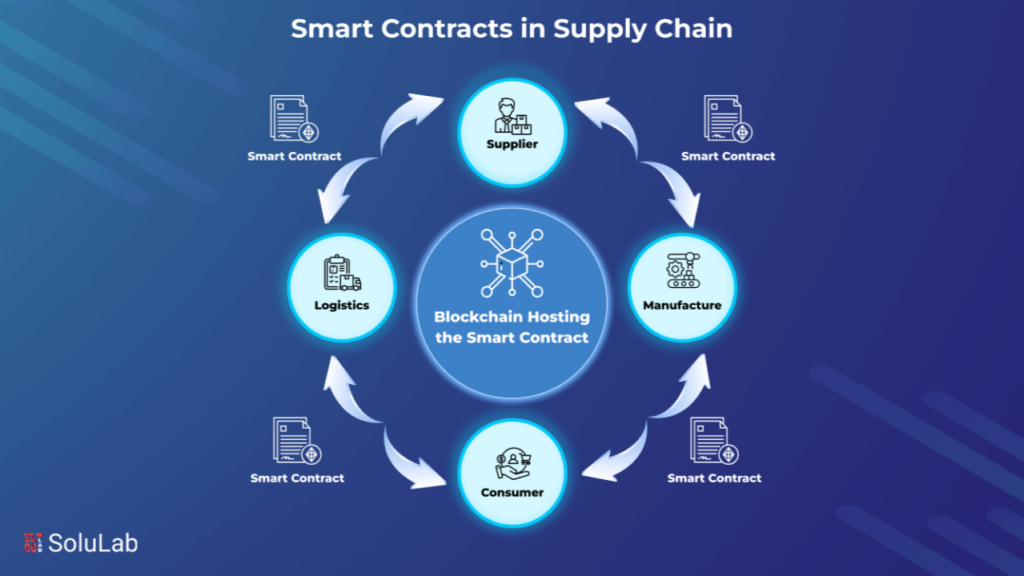
Improving Transparency Across Supply Chains
Smart contracts provide unprecedented visibility into payment processes.
All authorized stakeholders can access information regarding:
- Contract terms
- Payment status
- Shipment milestones
- Delivery confirmations
- Compliance records
This transparency reduces misunderstandings while improving collaboration between supply chain participants.
Businesses gain greater confidence that contractual obligations are being fulfilled accurately and efficiently.
Lowering Operational Costs
Administrative expenses represent a substantial portion of global logistics costs.
Blockchain-based payment automation can significantly reduce expenses associated with:
- Manual documentation
- Payment processing
- Contract reconciliation
- Compliance management
- Third-party verification services
By eliminating unnecessary intermediaries and automating routine procedures, businesses can improve operational efficiency at scale.
Industry analysts increasingly estimate that blockchain-driven automation has the potential to reduce operational costs across logistics networks significantly over time.
Enabling Cross-Border Commerce
International payments often face additional challenges, including:
- Currency conversions
- Banking delays
- Regulatory requirements
- Settlement complexities
Blockchain infrastructure supports faster and more seamless cross-border transactions.
Combined with tokenized payment systems and digital currencies, smart contracts may eventually enable:
- Near-instant settlements
- Reduced transaction fees
- Greater liquidity
- Improved global interoperability
The future of global trade is becoming increasingly digital and borderless.
Compliance and Auditability
Regulatory compliance remains a critical requirement for international logistics operations.
Smart contracts provide immutable records that simplify:
- Financial audits
- Regulatory reporting
- Contract verification
- Customs documentation
- Payment tracking
Auditors and regulators can review transparent transaction histories without relying on fragmented paper records.
This improves both accountability and operational resilience.
Challenges to Adoption
Despite their transformative potential, smart contracts face several implementation challenges.
Businesses must address:
- Legal recognition of smart contracts
- Technology integration
- Regulatory differences across jurisdictions
- Industry standardization
- Cybersecurity requirements
- Employee training
Adoption will require collaboration among governments, financial institutions, logistics providers, and technology companies.
However, the benefits of automation continue to drive substantial interest across industries.
The Future of Paperless Logistics
The logistics industry is rapidly moving toward digital ecosystems where:
- Contracts execute automatically.
- Payments settle instantly.
- Documentation is fully digitized.
- Compliance becomes more efficient.
- Supply chains operate with greater transparency.
In the near future, it may become standard practice for a shipment’s digital record to automatically trigger every subsequent contractual obligation.
Human involvement will increasingly focus on exception management rather than routine administrative tasks.
Global trade is becoming smarter, faster, and significantly more efficient.
Conclusion
The combination of blockchain technology and smart contracts is redefining how businesses conduct logistics payments and manage contractual relationships. By automating transactions based on real-world supply chain events, companies can eliminate unnecessary paperwork, reduce costs, improve transparency, and accelerate global commerce.
From customs clearance to final delivery, smart contracts enable payments to occur automatically when obligations are fulfilled—creating a seamless and trustworthy environment for international trade.
The transition toward paperless logistics is no longer a distant vision. It is already underway.
Businesses that embrace smart contract automation today will be better positioned to compete in a future where supply chains are digital, payments are instantaneous, and global commerce operates with unprecedented efficiency.