01 Jul

In today’s interconnected economy, businesses increasingly recognize that collaboration can be just as valuable as competition. Global supply chains have become so complex that even direct competitors often rely on shared infrastructure, common logistics networks, and industry-wide standards to deliver products efficiently and meet customer expectations.
However, collaboration presents a difficult challenge. How can competing organizations share critical operational data without exposing sensitive commercial information? How can businesses cooperate to improve supply chain transparency while protecting their intellectual property and competitive advantages?
Traditional centralized databases often fail to provide the level of trust, transparency, and security required for multi-party collaboration. Companies are understandably reluctant to grant competitors access to proprietary systems or rely on a single organization to manage shared information.
Blockchain technology is changing the rules of business collaboration. Through permissioned blockchain networks and industry consortia, competitors can securely exchange verified information while maintaining complete control over confidential data.
Rather than replacing competition, blockchain enables businesses to compete more effectively by collaborating where it matters most. The future of global commerce may not belong solely to individual enterprises—but to intelligent ecosystems where organizations work together to solve industry-wide challenges.
Why Modern Supply Chains Require Collaboration
Supply chains rarely operate in isolation.
Even competing businesses frequently depend upon:
- Shared transportation networks
- Common suppliers
- Port infrastructure
- Customs authorities
- Financial institutions
- Regulatory frameworks
- Industry certifications
Consider the global shipping industry. Multiple companies may use the same:
- Freight routes
- Warehousing facilities
- Customs procedures
- Logistics providers
Despite competing in the marketplace, these organizations benefit from efficient and transparent supply chain operations.
The challenge lies in determining which information should be shared and which must remain confidential.
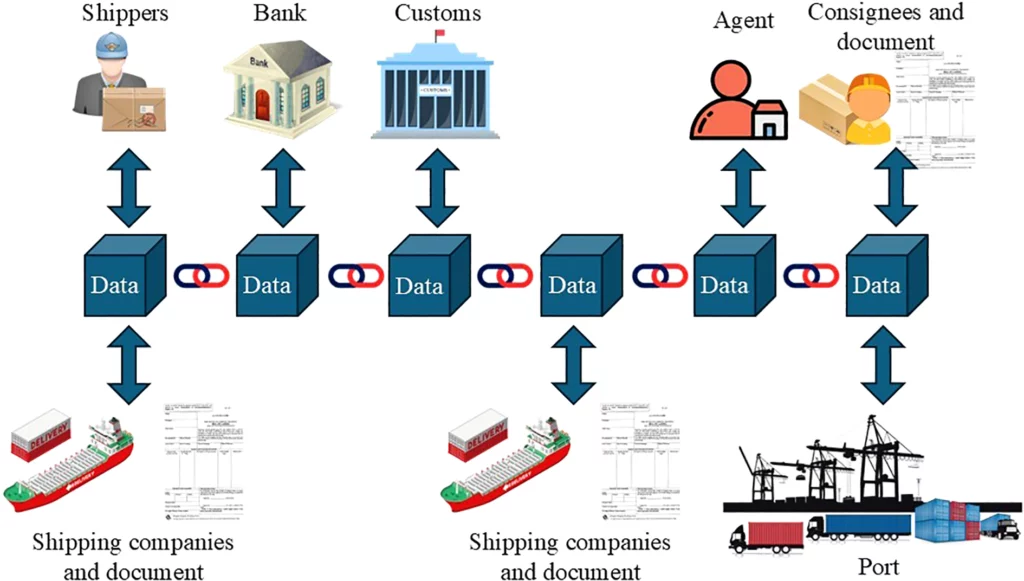
The Problem with Traditional Data Sharing
Collaborative business networks face several common obstacles.
Organizations are often concerned about:
- Data breaches
- Competitive intelligence risks
- Unauthorized access
- Centralized control of information
- Regulatory compliance issues
- Operational inefficiencies
Traditional approaches to data sharing typically rely upon:
- Centralized databases
- Manual reporting procedures
- Third-party intermediaries
- Multiple disconnected systems
These solutions can create trust issues among participants, particularly when competitors are involved.
Businesses require infrastructure that enables cooperation without compromising confidentiality.
Blockchain Creates Trusted Business Networks
Blockchain provides an ideal foundation for multi-party collaboration because it enables organizations to share verified information without relying upon a single controlling entity.
Permissioned blockchain networks allow participants to:
- Maintain ownership of their data.
- Define access permissions.
- Verify transactions securely.
- Share only necessary information.
Rather than exposing entire databases, organizations can selectively disclose specific supply chain events and operational records.
This creates a trusted environment where collaboration becomes both secure and practical.
What Is a Blockchain Consortium?
A blockchain consortium is a group of organizations that collectively operate and govern a blockchain network.
Participants may include:
- Manufacturers
- Logistics providers
- Retailers
- Financial institutions
- Regulatory agencies
- Technology partners
Unlike public blockchains, consortium networks provide:
- Controlled access
- Enhanced privacy
- Industry-specific governance
- Greater scalability for enterprise applications
Consortium members establish shared standards and rules governing how information is recorded and accessed.
This collaborative model has significant implications for global supply chains.
Sharing Data Without Sharing Secrets
One of blockchain’s most valuable features is its ability to separate transparency from complete disclosure.
Businesses can securely share:
- Shipment confirmations
- Compliance records
- Sustainability certifications
- Inventory milestones
- Quality assurance data
Without revealing:
- Pricing strategies
- Customer lists
- Proprietary manufacturing processes
- Commercial agreements
- Confidential business intelligence
Permissioned access controls allow organizations to determine precisely who can view specific information.
Collaboration becomes highly granular and customizable.
Improving Supply Chain Visibility
Supply chain visibility remains a major challenge across industries.
Limited transparency often leads to:
- Shipment delays
- Documentation discrepancies
- Compliance issues
- Operational inefficiencies
Blockchain consortia enable participants to access verified supply chain information in real time.
This improves:
- Inventory tracking
- Delivery coordination
- Customs processing
- Regulatory reporting
- Risk management
Every participant benefits from greater operational visibility while maintaining control over sensitive data.
Strengthening Industry Standards
Industry-wide collaboration frequently requires standardized processes and documentation.
Blockchain consortia provide a shared infrastructure capable of supporting:
- Common data formats
- Compliance requirements
- Quality assurance procedures
- Sustainability reporting
- Supply chain certifications
Standardization reduces administrative complexity and improves interoperability across organizations.
Businesses no longer need to maintain multiple incompatible systems to collaborate effectively.

Enhancing Trust Among Competitors
Trust is often one of the greatest barriers to industry collaboration.
Competitors naturally hesitate to share information if they fear:
- Data misuse
- Competitive disadvantages
- Lack of transparency in governance
Blockchain addresses these concerns through:
- Immutable records
- Transparent governance mechanisms
- Cryptographic security
- Permission-based access controls
Because no single participant controls the network, businesses can collaborate more confidently.
Trust is established through technology and governance rather than solely through contractual agreements.
Blockchain Consortia in Logistics
Logistics networks represent one of the most compelling applications of blockchain consortia.
Participants within a logistics ecosystem may share:
- Shipment statuses
- Customs documentation
- Warehouse information
- Transportation milestones
- Delivery confirmations
By collaborating through blockchain infrastructure, organizations can significantly improve:
- Supply chain efficiency
- Shipment visibility
- Regulatory compliance
- Customer service
Even direct competitors benefit when industry-wide inefficiencies are eliminated.
Supporting Regulatory Compliance
Global businesses face increasingly complex regulatory requirements.
Blockchain consortia simplify compliance processes by providing:
- Immutable audit trails
- Secure document sharing
- Real-time reporting capabilities
- Transparent verification mechanisms
Regulators may receive authorized access to specific compliance-related information without compromising commercial confidentiality.
This improves both regulatory oversight and operational efficiency.
ESG Reporting and Sustainability Initiatives
Environmental, Social, and Governance (ESG) initiatives increasingly require collaboration across supply chains.
Organizations must often verify:
- Carbon emissions
- Ethical sourcing practices
- Sustainability certifications
- Environmental compliance
Blockchain consortia enable businesses to securely share ESG-related data while maintaining appropriate privacy controls.
Transparent sustainability reporting becomes significantly more reliable when supported by immutable blockchain records.
Consumers, investors, and regulators all benefit from improved accountability.
Reducing Operational Costs
Industry collaboration frequently produces significant financial benefits.
Blockchain consortia can reduce costs associated with:
- Administrative processes
- Document management
- Compliance reporting
- Data reconciliation
- Third-party verification services
Shared infrastructure allows businesses to achieve economies of scale that would be difficult to accomplish independently.
Collaboration becomes a strategic advantage rather than an operational compromise.
Challenges to Consortium Adoption
Building successful blockchain consortia requires addressing several important challenges.
Organizations must establish:
- Governance frameworks
- Data-sharing policies
- Technical standards
- Regulatory compliance procedures
- Participant incentives
Consortium success depends upon aligning the interests of multiple stakeholders who may have differing business objectives.
Technology alone cannot solve collaboration challenges. Effective governance remains equally important.
The Future of Collaborative Commerce
The next generation of global supply chains will likely operate through interconnected business ecosystems rather than isolated corporate networks.
Blockchain consortia will enable organizations to:
- Collaborate securely.
- Share verified information.
- Improve industry standards.
- Reduce operational inefficiencies.
- Accelerate digital transformation initiatives.
Competition will increasingly coexist with collaboration.
Businesses will continue competing for customers and market share while simultaneously cooperating to strengthen the infrastructure that supports global commerce.
Conclusion
Blockchain technology is redefining how businesses collaborate by enabling competitors to share data securely without sacrificing confidentiality. Through consortium-based blockchain networks, organizations can improve supply chain transparency, strengthen compliance efforts, reduce operational costs, and enhance industry-wide efficiency.
The future of business collaboration lies not in choosing between competition and cooperation, but in understanding where each creates the greatest value. Blockchain provides the technological foundation that makes this balance possible.
As supply chains become increasingly interconnected, the organizations that thrive will be those capable of building trusted partnerships while preserving their unique competitive strengths.
In the digital economy, collaboration is no longer a weakness—it is becoming one of the most powerful drivers of innovation and sustainable growth.